
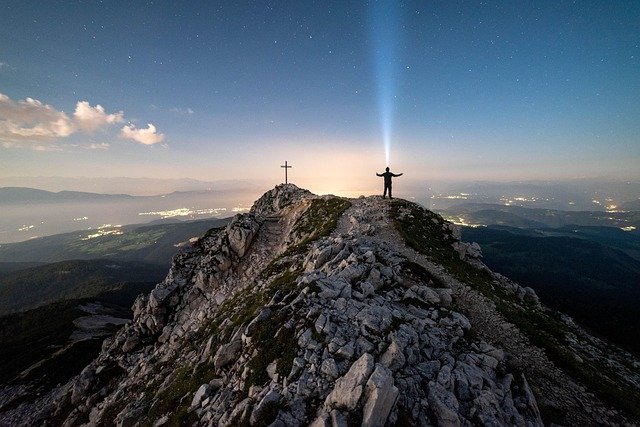
From the Cosmos to Christ
A few mornings ago, I woke unexpectedly at around three o’clock. The house was still. The room was silent. Yet my mind was anything but… Thoughts about space, time, gravity, eternity, and Scripture began flooding my heart faster than I could process them. Before I knew it, I reached for my phone and simply began writing.
At first, I thought I was simply recording a stream of thoughts. But as I continued to write, I sensed something deeper. It was as though the Lord was gently taking the very things that had fascinated me for years and using them to draw my heart toward Himself. My curiosity was no longer an end in itself; it was becoming an invitation to worship.
I began to realize that perhaps God doesn’t satisfy our deepest curiosity by answering every question about creation, but by revealing more of the Creator.
Looking back, I realized this wasn’t an isolated moment.
For years, God had been quietly nurturing within me a deep curiosity about the universe. Whenever I have the opportunity, I find myself listening to podcasts, watching documentaries, and reading about astronomy, cosmology, and the remarkable discoveries being made about our universe. Along the way, I’ve also found myself returning again and again to the movie Interstellar. I’ve probably watched it more times than I can count—not because I see it as a source of truth, but because it awakens wonder. It asks questions about time, gravity, space, and the vastness of the cosmos that have captivated humanity for generations.
As I reflected on that early morning, I began to wonder if perhaps God had been preparing my heart all along. Through years of curiosity, countless documentaries, books, conversations, and even a film that stirred my imagination, He was slowly teaching me that every genuine wonder of creation is meant to lead beyond itself—to the Creator.
I do not claim that everything I wrote that morning was a divine revelation. Every thought must always be tested against Scripture. Nor am I suggesting that the Bible was written to explain modern science. But that quiet morning reminded me of something beautiful: God can use even our curiosity to deepen our worship.
I am not an astrophysicist, nor am I a scientist. I am simply someone who is deeply curious. Neither am I a biblical scholar. I simply love reading God’s Word and quietly waiting for Him to teach me.
Over the years, I have become increasingly convinced that the God who inspired Scripture is the same God who authored the universe. Because of that, I do not see faith and science as enemies. Rather, when both are approached with humility, they lead us to stand in greater awe of God.
As I reflected on what modern science has uncovered, I began noticing something remarkable. While the Bible was never intended to be a scientific textbook, it consistently presents a worldview that points to a universe that is ordered, purposeful, and far greater than our limited human perspective.
Time and the God Who Stands Beyond It..
Albert Einstein’s theory of General Relativity demonstrated that time is not as absolute as we once imagined. Gravity influences the passage of time, meaning time itself is experienced differently depending on one’s circumstances. Interstellar illustrates this dramatically, where a few hours spent near an enormous black hole become years for those waiting elsewhere.
Long before modern physics described the relativity of time, Scripture revealed that God’s relationship with time is altogether different from ours.
“For a thousand years in your sight are like a day that has just gone by.” (Psalm 90:4)
“With the Lord a day is like a thousand years, and a thousand years are like a day.” (2 Peter 3:8)
These verses are not scientific explanations of relativity. They reveal something even greater: God is not bound by time because He is the Creator of time itself. Modern physics helps us appreciate just how mysterious time truly is, while Scripture reminds us that the Creator stands beyond it altogether.
The Invisible Reality..
Science also tells us that much of reality is invisible.
Gravity cannot be seen, yet it holds planets, stars, and galaxies together. Dark matter cannot be observed directly, yet astronomers infer its existence because of its effects. Space itself bends around massive objects, though our eyes cannot perceive it.
The writer of Hebrews offers a profound theological perspective:
“By faith we understand that the universe was formed at God’s command, so that what is seen was not made out of what was visible.” (Hebrews 11:3)
The author’s purpose was not to explain physics but to point us to the God who brought visible creation into existence. Yet I find it remarkable that the deepest structures of our universe are often unseen. Creation itself quietly reminds us that there is more to reality than what our eyes can perceive.
A Universe with a Beginning..
For centuries, many believed the universe had always existed. Today, the prevailing scientific understanding is that time, space, matter, and energy all came into existence together.
Thousands of years earlier, Scripture quietly declared: “In the beginning God created the heavens and the earth.” (Genesis 1:1)
Science continues to investigate how the universe began. Scripture answers the deeper question of Who brought it into existence. Modern astronomy has also revealed that the universe is expanding. Galaxies continue moving apart as space itself stretches.
What fascinates me is that the Bible repeatedly describes God as the One who “stretches out the heavens.” “He stretches out the heavens like a canopy.” (Isaiah 40:22). “He alone stretches out the heavens.” (Job 9:8)
These passages were never intended as cosmology textbooks. Rather, they beautifully portray creation as something sustained by God’s ongoing power rather than abandoned after its beginning. Even the universe reminds us that creation itself is not eternal. Stars exhaust their fuel. Galaxies evolve. Energy becomes increasingly unavailable as the cosmos moves toward greater disorder.
The psalmist wrote: “They will perish, but You remain… They will all wear out like a garment.” (Psalm 102:25–26)
Long before scientists described entropy, Scripture had already declared that creation is temporary while the Creator is eternal.
From the Cosmos to Christ..
One of the ideas explored in Interstellar that has always fascinated me is the concept of a wormhole. According to theoretical physics, a wormhole is a hypothetical bridge connecting two distant points in space and time. If such a bridge were ever found to exist, it could make an otherwise impossible journey possible.
Whether wormholes actually exist remains unknown. Yet the idea reminds me of something infinitely greater. Humanity’s greatest problem has never been the distance between galaxies. It has always been the distance created by sin between humanity and God.
No amount of intelligence…
No amount of scientific discovery…
No amount of technology…
No amount of morality…
No amount of religion…
No amount of human achievement… can bridge that divide. “For all have sinned and fall short of the glory of God.” (Romans 3:23)
That separation is not measured in light-years. It is measured by holiness.
Perhaps the longing behind the idea of a wormhole points us toward a far deeper reality—not because Jesus is a wormhole, but because every human heart longs for a way back to God.
Jesus declared: “I am the way and the truth and the life. No one comes to the Father except through Me.” (John 14:6). He also said: “I am the door. If anyone enters by Me, he will be saved.” (John 10:9)
Paul calls Him our Mediator. The writer of Hebrews calls Him our Great High Priest. What humanity could never accomplish through its own efforts, Christ accomplished through His death and resurrection.
What no bridge through space could ever achieve, the cross accomplished forever.
The Greatest Wonder
As I reflected on all these things, I realized that the greatest wonder is not black holes.
Nor dark matter…
Nor gravitational waves…
Nor wormholes…
Nor galaxies billions of light-years away…
The greatest wonder is Jesus Christ. The more I looked at creation, the more it seemed to whisper the same question: Who is the One behind all of this?
The apostle Paul answers that question with breathtaking clarity.
“The Son is the image of the invisible God, the firstborn over all creation. For in Him all things were created: things in heaven and on earth, visible and invisible, whether thrones or powers or rulers or authorities; all things have been created through Him and for Him. He is before all things, and in Him all things hold together.” (Colossians 1:15–17)
Everything I had been marveling at—space, time, gravity, galaxies, the invisible fabric of the universe—ultimately points to Him.
The One who designed every law of physics…
The One who called every galaxy into existence…
The One who stretched out the heavens…
The One who holds every atom together at this very moment…
And then Paul says something even more astonishing.
“And He is the head of the body, the church… For God was pleased to have all His fullness dwell in Him, and through Him to reconcile to Himself all things… by making peace through His blood, shed on the cross.” (Colossians 1:18–20)
The Creator became our Redeemer…
The One who spoke the universe into existence stepped into His own creation…
The One who exists beyond time entered history…
The One who holds galaxies together stretched out His hands upon a cross…
The One through whom all things were made willingly bore our sins so that those separated from God might be reconciled to the Father.
That is the greatest wonder in all the universe. Not simply that creation exists. But that its Creator loves us enough to redeem us.
Science can tell us how stars are born. Only the gospel tells us why the Creator came. Science can measure the age of galaxies. Only Christ offers eternal life.
Science invites us to explore creation. Jesus invites us to know its Creator.
The more I learn about the universe, the less interested I become in proving God through science. Instead, I find myself worshipping Him more deeply because the God who inspired Scripture is the same God who authored the universe. Perhaps that has been His invitation all along. As David declared,“The heavens declare the glory of God; the skies proclaim the work of His hands.” (Psalm 19:1)
They are still declaring His glory today. The question has never been whether God is speaking. The question is whether we are listening.
A Prayer..
Heavenly Father,
Thank You for revealing Your glory through both Your Word and Your creation. Forgive me for the times I become so fascinated with what You have made that I lose sight of You, the Maker of it all.
Give me a heart that never stops wondering, but let every question, every discovery, and every glimpse of the beauty and order of this universe lead me into deeper worship of Jesus Christ. May my curiosity never end with creation, but always find its fulfillment in the Creator.
Teach me to trust Your Word above my own understanding, to marvel at the works of Your hands, and to live each day in awe of the One who holds all things together. May the heavens continually remind me of Your greatness, and may my life continually declare Your praise.
In the name of Jesus Christ, through whom and for whom all things were created,
Amen.