THE LIGHT – Hope. Faith. Love.
“The light shines in the darkness, and the darkness has not overcome it.” — John 1:5 (NIV)
The Morning Light That Made Me Pause
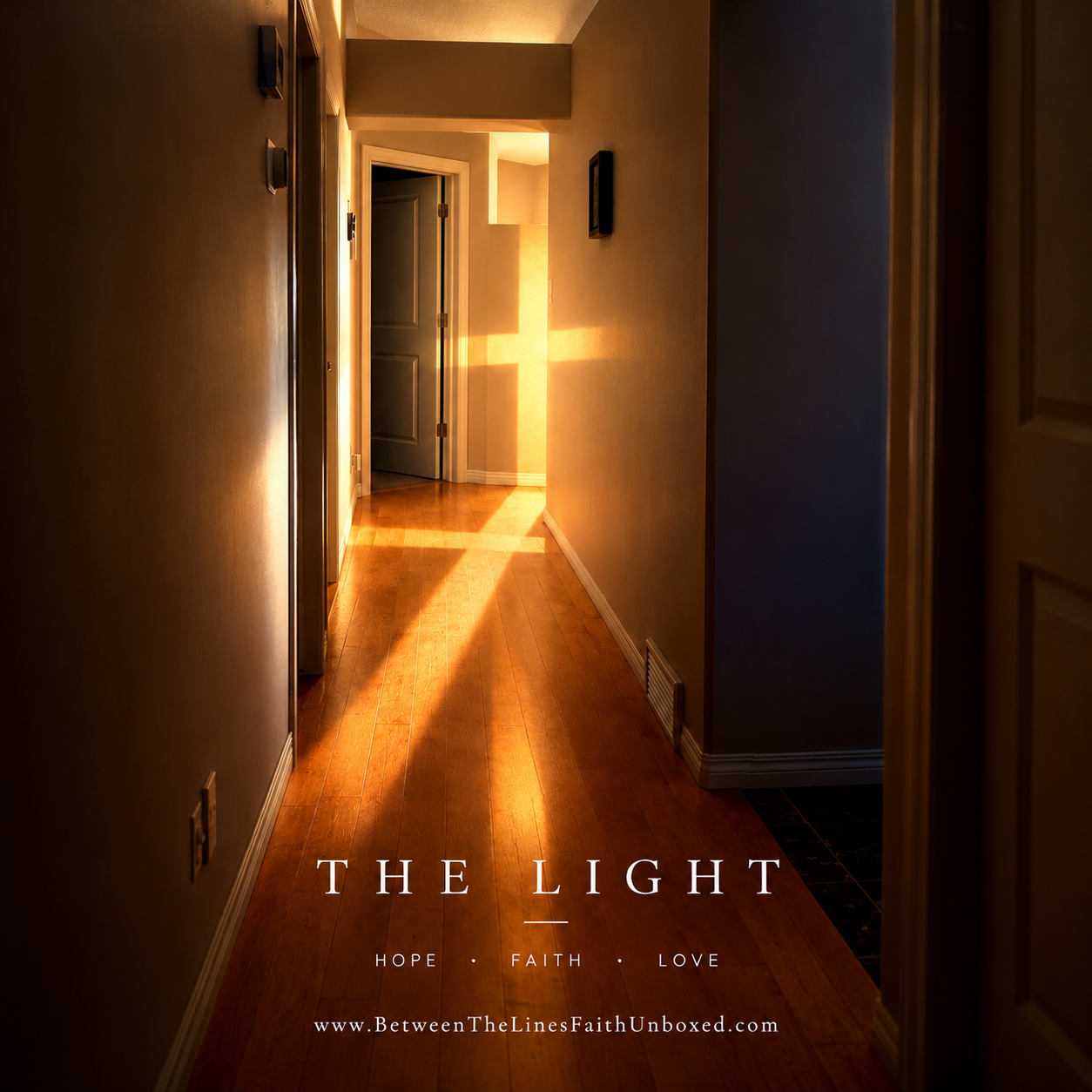
It was a Saturday morning. I had just woken up and walked out of my bedroom when something caught my attention. Sunlight was streaming into our home, falling across the hallway floor and the walls. But there was something about the way the light had entered that morning. The shadows it cast formed a shape that looked remarkably like a cross. My son and I saw it. It was one of those moments when you find yourself stopping, looking again, and wondering. There was no elaborate explanation, no dramatic event, just sunlight entering an ordinary home on an ordinary morning. Yet, something about that moment stayed with me.
I began thinking about light. And as I thought about light, I found myself thinking about the cross. The two came together in my mind in a way that made me pause and reflect.
I know that sunlight can form shapes and shadows through the ordinary arrangement of windows, walls, and objects. I do not need to conclude that what I saw was a supernatural sign to recognise that the moment stirred something meaningful in me. Sometimes, an ordinary moment can direct our attention towards a truth we have read many times but have not stopped to contemplate deeply.
That morning, the light entering my home became an invitation to reflect on the One who calls Himself the Light of the world, the cross through which He accomplished our redemption, and the calling He has given to those who follow Him. And I found myself asking:
What does it really mean to live in the light of Christ?
Not simply to know that Jesus is the Light. Not merely to speak about Him, sing about Him, or read about Him. But to live in His light, to allow His light to expose what needs to change within us, and to carry His light into a world that so desperately needs Him. The more I reflected, the more I realised that the story of light is woven throughout Scripture, from the very first chapter of Genesis to the final chapters of Revelation.
And perhaps we need to begin where the Bible begins…
1. Before There Was Light, God Was There
“And God said, ‘Let there be light,’ and there was light.” — Genesis 1:3 (NIV)
The Bible opens with a world that is formless and empty, with darkness over the surface of the deep. Before the creation account describes the sun, moon, and stars, God speaks light into existence. There is something significant about this.
Light does not emerge because darkness has found its own way out. Light comes because God speaks. God does not negotiate with the darkness. He does not ask it for permission to create. He speaks, and His command brings light.
The separation of light from darkness establishes an order within creation. The sun, moon, and stars are appointed later, in Genesis 1:14–18, to govern the day and night and mark seasons. The light of the first day, therefore, is part of a creation account that presents God as the sovereign Creator, bringing order and purpose where there was previously formlessness.
The passage is first about God’s creative authority, not a direct prediction of the cross. Yet, when we read it alongside the rest of Scripture, we begin to see a beautiful biblical theme emerge.
God is the One who brings light. Paul later draws upon the language of creation to describe what happens when someone comes to know Christ: “For God, who said, ‘Let light shine out of darkness,’ made his light shine in our hearts to give us the light of the knowledge of God’s glory displayed in the face of Christ.” — 2 Corinthians 4:6 (NIV)
Notice how Paul connects the beginning of creation with the work of God in the human heart. The God who commanded light to shine into the darkness of creation is the same God who shines His light into our hearts so that we may know Him through Jesus Christ.
Our encounter with Christ is not simply an improvement in our behaviour or the adoption of a religious identity. It is the work of God opening our eyes to His glory and bringing us into the knowledge of His Son. And that makes me think about my own life.
How many times have I walked through familiar places without noticing what was right in front of me? How many times have I read familiar passages of Scripture without allowing their truth to reach deeper into my heart?
Sometimes, the problem is not that there is no light. It is that I have become so accustomed to my surroundings that I no longer stop to look.
I can know the language of faith and still need God to illuminate areas of my heart that I have not fully surrendered to Him.
I can speak about grace and still struggle to extend it.
I can speak about truth and still resist it when it confronts me.
The light of Christ does not merely help me see the world more clearly. It helps me see myself more truthfully.
A moment to pause
- What areas of my life have become so familiar that I have stopped examining them in the light of God’s Word?
- Is there something God has already shown me that I have been reluctant to confront?
- Am I asking God only to change the circumstances around me, or am I also allowing Him to change what is within me?
Perhaps the first work of light is not to show me what is wrong with everyone else. Perhaps it is to help me see what God wants to transform in me.
2. The Light That Leads Us Through the Wilderness
“The LORD went ahead of them in a pillar of cloud to guide them on their way and by night in a pillar of fire to give them light.” — Exodus 13:21 (NIV)
The Israelites had been delivered from slavery in Egypt, but deliverance did not mean they immediately knew the way forward. They had left Egypt, but they were entering unfamiliar territory. There was a wilderness before them, a journey to undertake, and a future they could not yet see. God did not simply bring them out and leave them to find their own way. He went before them.. By day, a pillar of cloud guided them. By night, a pillar of fire gave them light.
The light was not merely something beautiful to behold. It served a purpose. It was connected to God’s presence and His guidance of His people. They did not need to know every detail of the journey before they could take the next step. They needed to follow the One who was leading them.
How often do we want God to show us the entire road before we are willing to walk?
We want clarity about the next five years, certainty about every decision, assurance that the difficult season will end soon, and an explanation for every unexpected turn. But faith does not always mean knowing where the entire road leads. Sometimes, faith means trusting God enough to take the next step in the light He has given us.
The psalmist expresses this beautifully: “Your word is a lamp for my feet, a light on my path.” — Psalm 119:105 (NIV)
A lamp for our feet does not necessarily illuminate the entire horizon. It provides light for the path ahead. God’s Word gives us truth by which to discern our steps, even when we cannot see everything that lies beyond them.
And this is where I find a personal challenge. It is possible to ask God for direction while quietly insisting that He must direct us according to our preferred timetable. We may want His guidance, provided it leads us along the road we have already chosen.
But following the light requires a willingness to move when He leads, wait when He says wait, and turn when His Word shows us that we are going in the wrong direction.
The question is not simply whether I have light.
The question is whether I am willing to follow it.
A moment to pause
- Am I trying to understand the whole journey before trusting God with the next step?
- Is there an area of my life in which I know what Scripture teaches, but I am hesitating to obey?
- When God’s direction differs from my expectations, do I still trust His wisdom?
The wilderness may be unfamiliar, but it is not beyond God’s sight. And the path may be difficult, but we do not have to walk it as people abandoned to darkness.
3. The Promise of Light in a Darkened World
“The people walking in darkness have seen a great light.” — Isaiah 9:2 (NIV)
Centuries before the birth of Jesus, Isaiah spoke of light breaking into darkness. The surrounding chapters describe judgment, distress, and the desperate need of God’s people. Yet, into this setting comes the promise of a great light. Isaiah 9:6 goes on to speak of a child who would be born and a son who would be given, whose names include Wonderful Counselor, Mighty God, Everlasting Father, and Prince of Peace.
Christians understand this passage in its fullest messianic sense through Jesus, whose coming brings God’s promised salvation and reign. Notice the setting of the promise. The light appears not because the world has finally made itself worthy of it, but because God acts to fulfil His purposes.
The biblical hope is not that humanity will eventually overcome every darkness through its own strength. It is that God has entered our broken human story to accomplish what we could not accomplish for ourselves.
This theme appears again in Isaiah 60:1–3: “Arise, shine, for your light has come, and the glory of the LORD rises upon you.” — Isaiah 60:1 (NIV)
The passage addresses Zion and describes God’s glory rising upon His people while darkness covers the earth. The order matters: God’s light comes first, and His people are then called to arise and shine. Their shining is a response to the light they have received. It is not self-generated glory.
It is not an invitation to believe that we are the source of our own spiritual light.
It is a calling to live in the light of God’s presence and purposes.
This distinction matters because we live in a world where darkness takes many forms.
We see hatred, violence, dishonesty, injustice, loneliness, and indifference. We see people wounded by betrayal and families struggling under pressures that others may never know about. But darkness is not limited to what we see in the headlines.
Sometimes it is the bitterness we carry long after someone has hurt us.
Sometimes it is the resentment we justify because we believe we have been wronged.
Sometimes it is the truth we avoid because acknowledging it would require us to change.
Sometimes it is the suffering of another person that we have learned to walk past because stopping would inconvenience us.
We may condemn the darkness in the world while overlooking the places where it seeks to take root in our own hearts. That is why the light of Christ must reach both outward and inward. It must shape the way we see others, the way we respond to injustice, the way we handle conflict, and the way we treat people who cannot offer us anything in return.
A moment to pause
- When I look at the darkness around me, do I respond with prayer, compassion, and faithful action, or only with criticism?
- Have I become so accustomed to the pain of others that it no longer moves me?
- Is there any darkness within me that I have excused simply because it has become familiar?
We cannot bring the whole world into the light through our own strength. But we can refuse to make peace with the darkness in our own lives. And we can allow the light God has given us to reach the people and places He has entrusted to our care.
4. The Light Has a Name: Jesus Christ
“I am the light of the world. Whoever follows me will never walk in darkness, but will have the light of life.” — John 8:12 (NIV)
The New Testament takes the theme of light beyond a metaphor for goodness, wisdom, or guidance. It brings us to a Person. Jesus does not merely say that He teaches the way to light. He declares, “I am the light of the world.” This is a profound claim about His identity and mission.
The opening verses of John’s Gospel take us back to the beginning: “In the beginning was the Word, and the Word was with God, and the Word was God.” — John 1:1 (NIV). John then writes that life was in the Word, and that life was the light of all mankind (John 1:4). He goes on to declare that the true light, which gives light to everyone, was coming into the world (John 1:9). The Word became flesh and made His dwelling among us (John 1:14). The One through whom all things were made entered the world He had made.
The eternal Son of God did not remain distant from human brokenness. He entered our history, took on human nature, and made the Father known. This is what makes Christian hope different from a general belief that light will eventually overcome darkness.
Our hope is anchored in Jesus Christ: His identity, His incarnation, His death, and His resurrection.
He is the Light because He reveals the Father, exposes the truth about our condition, and brings the life and salvation we cannot secure for ourselves. John 3:19–21 adds another dimension to this image. Jesus describes the tragedy of people loving darkness rather than light because their deeds are evil. Yet, the person who lives by the truth comes into the light.
Light does not always make us comfortable. Sometimes, we prefer darkness because it allows us to remain unchallenged. We may want Jesus to comfort us without correcting us, forgive us without transforming us, and guide us without questioning the direction in which we are already going. But the Jesus who comforts us is also the Jesus who calls us to repentance. The Jesus who receives sinners is also the Jesus who says, “Follow me.”
Grace does not mean that darkness no longer matters. Grace means that, through Christ, we are not left enslaved to it. And there is something else in Jesus’ words that I find deeply encouraging.
He does not merely say that He is light.
He invites people to follow Him.
The promise of John 8:12 is connected to discipleship. To follow Jesus is to trust Him, remain under His authority, learn His ways, and walk in the life He gives.
Christianity is not simply admiring the light from a distance. It is following the One who is the Light.
A moment to pause
- Is Jesus the centre of my life, or have I reduced Him to someone I turn to when I need help?
- Am I willing to let His truth challenge my attitudes, ambitions, relationships, and decisions?
- What would change in my daily life if following Jesus mattered more to me than protecting my comfort?
The light we need is not ultimately a philosophy, a technique, or a set of inspirational ideas. It is Christ Himself. And the invitation remains: follow Him.
5. The Cross: Where Light Meets Our Deepest Darkness
As I return in my thoughts to that Saturday morning, I find myself drawn to the relationship between the light and the shape that reminded me of a cross. I cannot say that the shape itself was a divine message. But it led me to reflect on something central to my faith: the cross of Jesus Christ. The cross was an instrument of suffering and death. Yet, at the centre of the Christian faith stands a crucified Saviour. How could what appeared to be the triumph of darkness become the place where God accomplished our redemption?
Matthew tells us that darkness came over the land from noon until three in the afternoon as Jesus hung on the cross (Matthew 27:45). The Light of the world was entering the depths of human suffering and death. Jesus, the One through whom all things were created, gave Himself for our sins. As Paul writes, God was reconciling the world to Himself in Christ (2 Corinthians 5:19). The cross reveals both the seriousness of our sin and the immeasurable depth of God’s love.
And the darkness did not have the final word. On the third day, Jesus rose again. The resurrection declares that death could not hold Him and that His saving work was not defeated. “The light shines in the darkness, and the darkness has not overcome it.” — John 1:5 (NIV)
This does not mean that those who follow Jesus will never experience suffering, grief, or uncertainty. It means that darkness does not have the ultimate victory. Sometimes, we cannot understand what God is doing in the middle of our pain. But the cross reminds us of His love, and the resurrection anchors our hope beyond what we can presently see.
Pause and reflect:
- When life becomes dark, do I measure God’s love by my circumstances, or remember what He has already demonstrated through the cross?
- What would it mean to trust in the hope of the resurrection even when I cannot yet see the way forward?
The cross reminds me that darkness is real, but it is not sovereign. Jesus Christ is Lord, and because He lives, our hope remains.
6. If Jesus Is the Light, What Does It Mean for Us to Shine?
Jesus declares: “I am the light of the world.” — John 8:12 (NIV). Yet, in Matthew 5:14, He tells His disciples, “You are the light of the world.” How can both be true?
Jesus is the source of our light. We do not replace Him or become the source of divine light ourselves. Rather, we are called to reflect His character and bear witness to His truth and love.
Jesus explains: “Let your light shine before others, that they may see your good deeds and glorify your Father in heaven.” — Matthew 5:16 (NIV). Notice the purpose: not that people should admire us, but that they might glorify God.
Paul echoes this calling in Ephesians 5:8: “For you were once darkness, but now you are light in the Lord. Live as children of light.” Living as light is not simply about speaking the right words or displaying our faith publicly. It is about allowing our faith to shape the way we live.
It is choosing honesty when dishonesty would be easier. It is showing patience when we are frustrated, extending forgiveness when we have been hurt, and treating people with dignity even when we have nothing to gain from them. And perhaps the first place this light should become visible is in our own homes.
It is possible to speak graciously in public while being impatient with those closest to us. We can encourage others to practise kindness while overlooking the needs of our own families. But the light of Christ is meant to reach every part of our lives—our homes, workplaces, relationships, and ordinary conversations.
We do not have to be perfect to reflect His light. We must be willing to grow, repent when we fail, and allow His grace to shape us.
Pause and reflect:
- Do the people closest to me experience the love and patience I speak about?
- If someone observed my life without hearing me talk about Jesus, what might they learn about Him from the way I live?
- Am I seeking to draw attention to myself, or to point others towards Christ?
Because He is the Light, we are called to reflect His light—not to glorify ourselves, but to make His goodness visible.
7. Walking in the Light Means Living in Truth
Light does more than illuminate what is around us. It reveals what has been hidden. John writes: “If we walk in the light, as he is in the light, we have fellowship with one another, and the blood of Jesus, his Son, purifies us from all sin.” — 1 John 1:7 (NIV)
Walking in the light does not mean pretending that we have no sin. In fact, John warns against precisely that kind of self-deception in 1 John 1:8. It means living honestly before God, acknowledging our failures, and depending on the grace and cleansing we receive through Christ.
Sometimes, the light exposes pride we have justified, bitterness we have carried, or attitudes we have been unwilling to confront. Our response matters.
Will we become defensive, or will we allow God to transform us? The good news is that we do not have to hide our brokenness from the One who came to redeem us. Through Christ, we can confess our sins, receive forgiveness, and learn to walk differently.
Walking in the light is not about maintaining a perfect image. It is about becoming more truthful, humble, and willing to change.
Pause and reflect:
- Is there something God is bringing to my attention that I have been reluctant to acknowledge?
- Am I more concerned about appearing spiritually mature than about becoming more like Christ?
The light that reveals our need is also the light that leads us towards grace. We do not come to Jesus because we have nothing to confess. We come because He is the One who can forgive, cleanse, and transform us.
8. Carrying His Light into a Dark World
We live in a world where darkness takes many forms: injustice, hatred, dishonesty, loneliness, and indifference. But Jesus has not called us merely to point out the darkness. He has called us to shine.
Sometimes, that means standing for truth when it costs us something. Sometimes, it means refusing to participate in gossip, choosing integrity over personal advantage, or extending kindness to someone who has been overlooked. Yet, we must remember that shining does not mean becoming harsh or self-righteous.
Peter tells believers to be ready to explain the hope they have, doing so with gentleness and respect (1 Peter 3:15). That is the balance we are called to maintain: conviction without arrogance, truth without cruelty, and love without abandoning what is right. Not every disagreement means we are being persecuted for our faith. Sometimes, we must also examine whether our own attitudes have failed to reflect Christ.
The world needs more than people who speak about light. It needs people whose lives bear witness to the One who is the Light. People who pursue justice without hatred, speak truth with humility, and remain compassionate even when it is difficult.
We cannot remove every darkness around us. But we can choose not to contribute to it.
Pause and reflect:
- In the places God has entrusted to me, am I bringing peace, truth, and compassion?
- When I stand for what is right, can others still see the character of Christ in the way I respond?
We are not called to manufacture the dawn. We are called to remain faithful to Jesus and reflect His light wherever He has placed us.
9. The Story Ends in Light
The Bible begins with God speaking light into creation. It ends with a vision of a new creation illuminated by His glory.
John writes: “The glory of God gives it light, and the Lamb is its lamp.” — Revelation 21:23 (NIV)
The Lamb is Jesus Christ, the One who was slain and rose again. The same Christ who entered our darkness is at the centre of the glorious future God has promised His people. Revelation 22:5 declares that God’s people will no longer need the light of a lamp or the sun, because the Lord God will give them light.
What a beautiful conclusion to the biblical story!
From the light of creation to the Light who came into the world, from the cross to the resurrection, Scripture points towards the day when God’s redemptive purposes will be fulfilled. Our hope is not that humanity will eventually overcome every darkness through its own strength. Our hope is in the God who promises to make all things new (Revelation 21:5).
We do not know everything the future holds, but we know the One in whom our future rests. And that hope should shape how we live today.
Pause and reflect:
- Does the hope of Christ’s promised future influence the way I live in the present?
- Where do I need to hold on to God’s promises rather than allow present circumstances to determine my hope?
The final word of the Christian story is not darkness, death, or despair. It is the glory of God and the presence of the Lamb. And that is where our hope rests.
10. Returning to That Saturday Morning
When I think back to that Saturday morning, I remember the sunlight falling across our hallway and the shape that reminded me of a cross. An ordinary moment had made me stop and reflect.
I cannot say that the shape itself carried a divine message. But it reminded me of a truth that remains central to my faith: the light we need most is not sunlight entering our homes, but the light of Christ illuminating our lives. And the cross brought the reflection closer to home. The question is not simply whether I can see the shape of a cross in a beam of sunlight.
It is whether the reality of the cross is shaping the life I live.
Am I becoming more patient because I have received God’s grace? More forgiving because I understand how much I have been forgiven? More truthful because I am learning to walk in His light? Am I becoming more compassionate towards people whose struggles I may never fully understand?
These are questions I must continue to bring before God. Because faith is not simply about a moment that moves us. It is about a life that is continually being shaped by Christ. The light may enter our homes through a window, but its impact should reach far beyond our walls.
It should be seen in the words we choose, the burdens we help carry, the people we refuse to overlook, and the hope we hold when life becomes difficult. We may never know how far a small act of faithfulness will reach. But we can choose to live faithfully today.
Jesus said, “I am the light of the world” (John 8:12). And He calls His followers to be the light of the world (Matthew 5:14).
The first is the foundation of the second. Because He is the Light, we can walk in His light. Because He has shown us grace, we can extend grace. Because He has loved us, we can love others.
The light is not ours to own. It is ours to reflect. And the One we reflect is Jesus Christ.
A Final Invitation
Before moving on, take a moment to be still. Think about the people you will encounter today and the places God has entrusted to your care.
Ask yourself: Where is Christ inviting me to walk more fully in His light? Is there something I need to surrender? Someone I need to forgive? A truth I need to acknowledge? A person I have overlooked?
Do not rush to answer. Let the questions sit with you. The invitation is not to leave feeling condemned, but to respond to God’s grace with an open heart and a willingness to follow Him.
The light that reveals our need also leads us to the One who forgives and transforms us. And the light that leads us to Christ is the light we are called to reflect in the world.
A Prayer
Lord Jesus,
You are the Light of the world. Thank You for entering our darkness, giving Yourself for our redemption, and becoming our everlasting hope. Shine Your light into my heart. Transform me by Your truth, fill me with Your love, and help me reflect Your grace in my home, my relationships, and wherever You lead me.
When darkness surrounds me, remind me that You have overcome the world. May my life point others not to myself, but to You. Until the day I see Your glory, help me walk in Your light, live in Your love, and hold firmly to Your hope.
In Jesus’ name, Amen.
THE LIGHT — Hope. Faith. Love.
May we never be so fascinated by the light we see that we forget the One who is the Light. And may we never be so occupied with pointing out the darkness around us that we forget to let Christ’s light transform the darkness within us.
— Between the Lines | Faith Unboxed